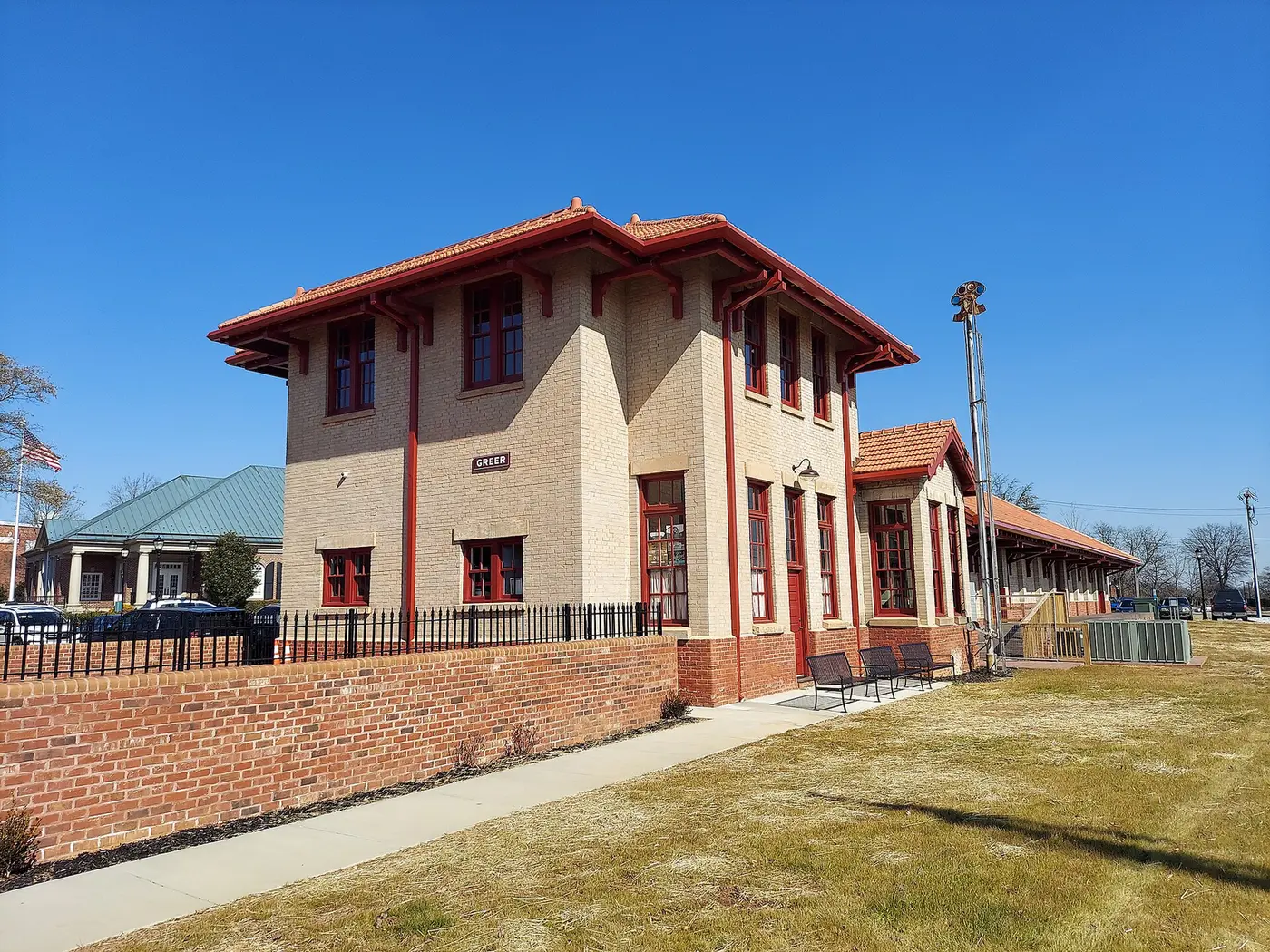
Greer was incorporated March 25, 1876, around a railroad depot. Its National Register sites, the Greer Heritage Museum (free, 106 S. Main St.) and more.
Last checked Oct. 16, 2026. History comes from the City of Greer’s About Greer and Greer150 pages; listing dates come from the National Park Service’s National Register records on NPGallery.
Greer grew up around a railroad depot set in farmland between Greenville and Spartanburg, and the city is marking its 150th birthday in 2026 with a year of Greer150 events. The line between Greenville and Spartanburg counties still runs through town along Line Street.
Visit the history
- Greer Heritage Museum: 106 S. Main St., 864-877-3377. Open 10 a.m. to 4 p.m. Tuesday to Saturday, noon to 4 p.m. Sunday. Free.
- Ghost tours: walking tours run all October; tickets at greerheritage.com/ghosts
- Christmas at the Museum: Saturday, Dec. 12, at 10 a.m., 1 p.m. and 4 p.m. (free, registration required)
How Greer began
Cherokee people lived on the land long before European settlers arrived. Line Street, which now divides Greenville and Spartanburg counties, follows the old Indian Boundary Line: the Cherokee Nation deeded what is now the Spartanburg County side of Greer to the South Carolina Province in 1761 and ceded the other side in 1777, according to the city’s history.
In the 1870s James Manning Greer owned about 200 acres of farmland here and sold part of it to the Atlanta and Richmond Air-Line Railway, which was building a line between Greenville and Spartanburg. William Shumate bought the rest of Greer’s land, betting a town would grow where the tracks crossed the Old State Road, and sold lots for $25 to $75 an acre. The railroad named its stop “Greer’s Depot,” which also held the area’s first post office.
On March 25, 1876, 15 men voted unanimously to incorporate the town of “Greer’s.” The first mayor was William C. Bailey, and the first council members were Dr. H.V. Westmoreland, W.A. Hill, David Cannon and A.J. Morgan. The town formally became Greer in 1904, according to the city’s Greer150 timeline.
By 1914 two railroad lines ran through Greer. Textile mills drove growth, and farmers shipped peaches and other crops by rail; the Jones Brothers company’s canned peaches and tomatoes put “Greer” on grocery labels across the country. By the 1950s Greer had a new hospital, a high school and a busy downtown of clothing stores that drew shoppers from Greenville and Spartanburg. The city now describes itself as a hub for international commerce and advanced manufacturing; BMW, which opened its plant in the Greer area 30 years ago, employs more than 11,000 people, according to the city’s economic development page.
National Register of Historic Places
Listings in and around Greer, with the date each was listed, from National Park Service records:
| Place | Address | Built or significant | Listed |
|---|---|---|---|
| Gilreath’s Mill | About 4 miles northwest of Greer on SC 101 | 1839 | May 28, 1976 |
| Arthur Barnwell House | South of Greer on SC 14 | 1880 | March 19, 1982 |
| Greer Depot | 311 Trade St. | 1913 | March 6, 1987 |
| Louie James House | 401 W. Poinsett St. | 1923 | Sept. 19, 1996 |
| Greer Downtown Historic District | Roughly Trade, E. Poinsett, Randall, Victoria and N. Main streets | 1900-1924 period | Sept. 18, 1997 |
| Davenport House | 100 Randall St. | 1921 | Feb. 1, 1999 |
| R. Perry Turner House | 211 N. Main St. | 1937 | Feb. 1, 1999 |
| Robert G. Turner House | 305 N. Main St. | 1935 | Feb. 1, 1999 |
| Greer Post Office | Now the Greer Heritage Museum, 106 S. Main St. | 1935 | 2011 |
| Earle R. Taylor House and Peach Packing Shed | Greer vicinity | 1925, 1935, 1939 | 2012 |
| Apalache Mill | Apalache, near Greer | 1888 | Dec. 15, 2015 |
Most of these are private homes and businesses; view them from the street. The Greer Depot, designed by architect Charles Christian Hook, was restored in 2021 and is now an event venue, according to its operator.
For a fuller inventory, the city’s Board of Architectural Review points to the 2017 City of Greer Cultural Resources Survey, known as the Brockington Survey, which covers the city’s historic buildings.
Museums and places to visit
Greer Heritage Museum, 106 S. Main St. The museum moved into the historic 1935 Greer Post Office in 2008 after working with the city, according to its history. It is free, fully accessible by a side ramp, and open 10 a.m. to 4 p.m. Tuesday through Saturday and noon to 4 p.m. Sunday, according to the museum. It has no lot of its own; park in the free city lot across the street, the lot beside the fire station at 149 W. Poinsett St., or the city parking garage. The museum celebrated its 30th birthday in September 2026; David Lovegrove has been executive director since 2021.
Mountain View Cemetery, entrances on North Avenue. The city-owned cemetery asks visitors to respect the grounds; recreation, exercise, food, drinks and tobacco are not allowed, according to the city. Questions go to Public Services at 864-848-2184.
Victor Memorial Veterans Park, 50 17th St., started in 1995 by the Greer chapter of the Disabled American Veterans and the city, with a Cobra helicopter and a mortar carrier on display. See our parks guide.
BMW Zentrum Museum hosted the Greer150 “Rebirth” history program on Aug. 29, 2026.
Greer150: the rest of 2026
- Greer Ghost Tours, all October: walking tours of Trade Street and the town’s first cemetery, with tickets on the museum’s site.
- 150 Years of Christmas, Saturday, Dec. 12, Greer Heritage Museum, at 10 a.m., 1 p.m. and 4 p.m.
What this means for you
- Start at the Greer Heritage Museum; it is free and open six days a week.
- Walk Trade Street from the depot to see the downtown historic district.
- Own an older building downtown? Changes in the historic district go to the Board of Architectural Review first; see our permits guide.
Related guides: Greer population and growth, parks and trails in Greer and things to do in Greer this month.
Frequently asked questions
When was Greer, South Carolina, founded?
Greer was incorporated on March 25, 1876, when 15 men voted unanimously to charter the town of Greer’s around the railroad depot. The town formally became Greer in 1904, according to the city.
Who is Greer named after?
James Manning Greer, who owned about 200 acres in the area in the 1870s and sold land to the Atlanta and Richmond Air-Line Railway. The railroad named its depot Greer’s Depot after him.
What are the Greer Heritage Museum’s hours?
The museum at 106 S. Main St. is open 10 a.m. to 4 p.m. Tuesday through Saturday and noon to 4 p.m. Sunday. Admission is free; call 864-877-3377.
What is on the National Register of Historic Places in Greer?
The Greer Downtown Historic District, the Greer Depot, the Greer Post Office, the Davenport House, the Louie James House, the R. Perry Turner and Robert G. Turner houses, Apalache Mill and the Earle R. Taylor House and Peach Packing Shed, among others.
Have your say